They rolled their eyes at this tragic reality.
By Jennifer Stoeckl, MAT - Dire Wolf Project CEO, April 21, 2026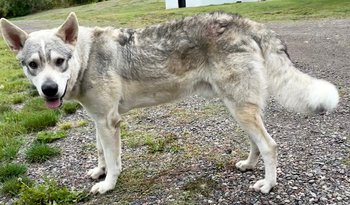
There is something almost predictable about what happens whenever the Dire Wolf Project™ shows the public an American Dirus™ dog with real prehistoric weight behind it.
Someone implies we are trying to make a wolfdog.
Someone insists our dogs do not look like wolfdogs at all.
And before long, a breeder of wolfdogs or wolf-like dogs appears to declare that their animals look “wolfier” than ours, as though that settles the question.
That happened again this week on our Facebook page.
After we posted our wolfdog versus DireWolf Dog™ meme, one breeder objected that our statements about wolfdogs were “absolutely incorrect.”
Another woman laughed that even her long-coated AKC German Shepherd Dogs looked more like wolfdogs than our dogs.
That response revealed the entire confusion that lingers from so many who just don’t take the time to learn about us before speaking up.
Most measure our dogs against the modern gray wolf.
Yet, it’s such a false comparison.
The Dire Wolf Project™ was never built around copying the modern wolf.
We are not trying to recreate the lean frame, lighter build, narrower substance, and present-day wolf phenotype that wolfdog breeders chase by adding recent wolf blood.
Our aim reaches much farther back into the fossil record toward the extinct dire wolf, an animal with heavier bone, a broader and more substantial body, a deeper impression of power, and a very different prehistoric presence.
That distinction is not simply cosmetic.
It changes the entire breeding philosophy.
A wolfdog breeder always gets closer to a modern wolf look by deliberately crossing domestic dogs with recent wolf content.
The visual wolf-like effect can appear in a single generation because the wolf ancestry is immediate.
The tradeoff is that the breeder is also importing the unpredictability, containment difficulty, legal complications, roaming tendency, and placement risk that keep sanctuaries, rescues, and shelters dealing with the wreckage long after the puppy photographs stop circulating online.
Our project outright rejects that shortcut.
We are not adding recent wolf blood to create a dramatic appearance and then hoping temperament sorts itself out later.
We are doing the harder work of multi-generational domestic selection.
That means breeding dog to dog, generation after generation, while deliberately choosing for calm family temperament, deep human bonding, emotional steadiness in the home, and structural traits that move the phenotype toward the prehistoric dire wolf rather than the modern gray wolf.
That is why a comment about looking “wolfy” completely misses the point.
“Wolfy” is not our target.
Prehistoric is our target.
Domestic is our requirement.
The mission is not to produce a dog that looks ready to disappear into the timber.
The mission is to produce a dog that carries the visual gravity of deep time while remaining fit for modern human life.
In other words, we are trying to preserve an ancient canine silhouette without sacrificing the domestic mind.
This is also why the usual wolfdog defense collapses under scrutiny.
The argument is almost always emotional.
People say critics “do not understand” wolfdogs because they do not own one.
They roll their eyes when anyone mentions instability, failed placements, or the terrible welfare outcomes tied to this niche.
They act as though affection for individual animals somehow erases the broader pattern.
It does not.
Across the United States, rescues, sanctuaries, and shelters have been left dealing with the fallout of this breeding culture for years.
The exact national totals are difficult to pin down because wolfdogs are inconsistently identified and poorly tracked, but the pattern itself is clear enough to see without squinting.
Animals are bred because the puppy looks striking, exotic, or primal.
Buyers are captivated by the fantasy.
Then the adult animal collides with real life.
- The fence is not high enough.
- The landlord says no.
- The county regulations change.
- The insurance company refuses coverage.
- The dog becomes difficult to place.
- A rescue is contacted.
- A sanctuary is already full.
- A shelter has no realistic outlet.
And in far too many cases, the animal is abused, abandoned, or euthanized because human beings created a life they were never truly prepared to carry to its natural end.
That is the real cost of wolfdog breeding and ownership.
That is what I mean when I say the animal pays.
It pays with:
- instability in placement.
- abandonment.
- confinement.
- being bounced from one set of hands to another.
- sometimes, with its life.
This is why I have no patience for breezy dismissals from breeders who pretend there is no problem.
At that point there are only two options.
- Either they genuinely do not know what rescues, sanctuaries, and shelters have been reporting for years, which would make them alarmingly ignorant of the consequences of their own niche,
- Or they do know and continue speaking as though those outcomes do not count, which is worse.
Neither possibility inspires confidence.
Meanwhile, here at the Dire Wolf Project™, we are laboring toward a very different end.
We are asking a more difficult and more disciplined question:
How far can the domestic dog be shaped toward an ancestral, prehistoric form while still becoming an even better family companion for modern human life?
That is a breeding question; it is also a moral one.
It requires:
- long memory, ruthless honesty, and a willingness to reject seductive shortcuts.
- decades, not impulse.
- a breeder to care what becomes of the animal at two years old, five years old, and ten years old, not merely at eight weeks old when the puppy is adorable and marketable.
So yes, let them say our dogs are not wolfdogs.
They are right.
Our dogs are not wolfdogs.
They are not meant to be.
They are American Dirus™ dogs, and that difference is the whole argument.
If you want to help defend that distinction in public, the debate is unfolding right now on our Facebook page.
Wolfdog breeders and their allies have entered the comments insisting we have misunderstood the wolfdog and that our dogs do not resemble theirs.
Go read what they’ve posted.
Then stand up for the truth and answer with facts, not emotion.
Remind them that:
- We are not breeding toward the modern gray wolf in the first place.
- The extinct dire wolf is not the same animal as a wolf.
- A wolf-like look achieved through recent wolf ancestry is not equivalent to a deliberately domesticated dog shaped over generations toward a prehistoric silhouette.
- No amount of eye-rolling erases the suffering left behind when fantasy breeding collides with real life.
You can join the discussion here:
https://www.facebook.com/direwolfproject
Come stand with the pack and help hold the line where facts, history, and moral responsibility meet.
===
P.S. In order to help you, I’ve posted a .pdf of the verified statistics from credible sourcing of wolfdog abandonment and euthanasia on our Dire Wolf Project™ Learnistic app.
Look for it here:
Natural History Museum —> Extras —> Wolfdog vs. DireWolf Dog
===
P.P.S. Mother’s Day is right around the corner. Our latest design has popped up at the Dire Wolf Project™ Gift Shop. For this design only, we’ve included a PURPLE color option.
Check it out at:
https://shop.direwolfproject.com/products/love-runs-deep-design
Jennifer Stoeckl is the co-founder of the Dire Wolf Project, founder of the DireWolf Guardians American Dirus Dog Training Program, and owner/operator of DireWolf Dogs of Vallecito. She lives in the beautiful inland northwest among the Ponderosa pine forests with her pack of American Dirus dogs.