Is the Beringian wolf a dire wolf hybrid?
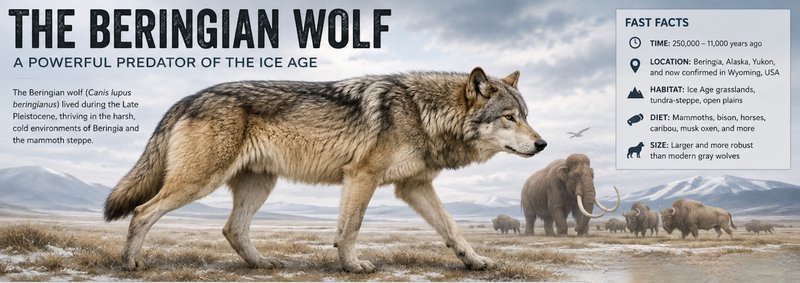
For nearly two decades, paleontologists have recognized the now extinct Beringian wolf as one of the most remarkable predators of the Ice Age. It was larger and more heavily built than most gray wolves, with a broad skull, powerful jaws, and teeth worn from crushing the bones of mammoths, horses, and ancient bison. Yet despite its impressive appearance, relatively few people have ever heard of it.
At first glance, the Beringian wolf seems easy enough to explain. Most researchers consider it an unusual population of ancient gray wolves that evolved in the frozen north during the last Ice Age. But then the questions begin.
Why did it look so different from other gray wolves?
Why did it develop a skull and jaws that seem surprisingly similar to those of the dire wolf?
Why was it once believed to live only in Alaska and the Yukon, only to be discovered much farther south in Wyoming?
And perhaps the biggest question of all...
Could there be more to the Beringian wolf's story than we currently understand?
Before anyone reaches for the pitchforks, let's be perfectly clear. There is currently no scientific evidence demonstrating that the Beringian wolf was a hybrid between the dire wolf and the gray wolf. There is also a very important detail that almost no one talks about. No published study has ever been designed specifically to test the possibility that the Beringian wolf was a hybrid between the dire wolf and the gray wolf. That may sound like a small distinction, but in science, it makes all the difference.
The purpose of this article is not to convince you that the Beringian wolf was a hybrid. It is to examine the evidence we have, acknowledge the evidence we don't have, and ask whether this fascinating possibility deserves a closer look.
Meet the Forgotten Wolf of the Ice Age
Until 2007, the Beringian wolf didn't officially exist.
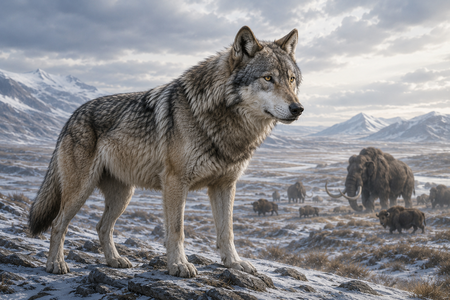
Of course, the animal itself had been running across the frozen plains of North America for thousands of years. It had hunted mammoths, horses, ancient bison, musk oxen, and caribou long before the first humans ever wrote a history book. But paleontologists had never recognized it as something unique.
Instead, its bones were simply labeled as large gray wolves.
That changed when a remarkable team of researchers led by paleontologist Dr. Jennifer Leonard began taking a much closer look.
Rather than examining only the size of the bones, Leonard's team combined several branches of science into one investigation. They carefully measured skulls and teeth, analyzed microscopic wear patterns left behind by the animals' diet, studied the chemistry preserved inside the bones, radiocarbon dated the fossils, and recovered ancient mitochondrial DNA from remarkably well-preserved specimens.
Piece by piece, a different picture began to emerge.
These wolves were unlike the gray wolves living today.
Their skulls were broader.
Their jaws were deeper and more heavily built.
Their carnassial teeth, the large shearing teeth that every wolf uses to slice meat, were noticeably larger and more robust. Many of the teeth showed heavy wear, chips, and fractures consistent with a lifetime of cracking bones. These were not wolves surviving on rabbits and deer. They were predators built for a world filled with giants.
Their menu likely included step bison, ancient horses, musk oxen, caribou, and perhaps even mammoths whenever the opportunity presented itself. Everything about their anatomy suggested tremendous bite strength and the ability to consume nearly every part of a carcass, including the nutritious marrow hidden deep inside massive bones.
Then came another surprise.
When Leonard's team analyzed the animals' mitochondrial DNA, they recovered sixteen different maternal lineages, known as haplotypes, from just twenty wolves. Six of those lineages matched wolves that had lived thousands of miles away in Ice Age Europe, while the remaining lineages had never been identified in modern North American gray wolves. Suddenly, these animals looked less like an unusually large gray wolf and more like the last surviving members of an ancient world that had almost completely disappeared.
The researchers gave this newly recognized predator a name that reflected where it had first been studied.
The Beringian wolf.
At the time, scientists believed these wolves lived almost exclusively in eastern Beringia, the vast Ice Age landscape that connected present day Alaska, the Yukon, and Siberia when sea levels were much lower than they are today. It seemed to be a highly specialized predator that had evolved alongside the mammoths and other great herbivores of the north.
For a while, that appeared to settle the mystery.
Then Wyoming entered the story.
Then the Story Took an Unexpected Turn
For nearly a decade after the Beringian wolf was first described, scientists believed they had a fairly good idea where it had lived.
Its home was eastern Beringia, the vast Ice Age landscape that stretched across present day Alaska and the Yukon. During the last Ice Age, this frozen grassland was home to mammoths, steppe bison, ancient horses, musk oxen, caribou, and one of the most formidable wolves the world has ever known.
That picture seemed complete.
Then researchers looked inside a cave in northern Wyoming.
Not just any cave.
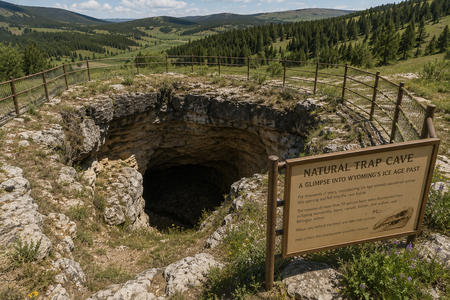
A place known as Natural Trap Cave.
Unlike most caves, Natural Trap Cave is exactly what its name suggests. For thousands of years, unsuspecting animals wandered across what appeared to be solid ground. Hidden beneath a thin opening was an 85 foot deep chamber. Once an animal slipped through the opening, there was no climbing back out. Over thousands of years, the cave quietly collected the remains of Ice Age wildlife like a giant time capsule waiting to be discovered.
Among the thousands of fossils recovered were the bones of several wolves.
For decades, no one knew exactly what they were.
Some scientists thought they were simply large gray wolves. Others noticed that their skulls seemed unusually short and broad. They looked... different.
Finally, in 2016, paleontologist Dr. Julie Meachen and her colleagues carefully compared the Wyoming wolves to three groups: modern gray wolves, dire wolves, and the Beringian wolves that Jennifer Leonard had previously described from Alaska and the Yukon.
The results surprised everyone.
The Wyoming wolves did not group with modern gray wolves.
They did not group with dire wolves.
Instead, their skulls, jaws, and teeth matched the Beringian wolves of Alaska. The evidence suggested that these remarkable Ice Age wolves had traveled more than a thousand miles farther south than anyone had previously imagined.
That discovery changed far more than a dot on a map.
It changed the way scientists thought about the Beringian wolf itself.
Perhaps it wasn't simply an "Alaskan wolf" after all.
Perhaps it was a highly specialized predator that followed the great herds of the mammoth steppe wherever they wandered. As the glaciers advanced and retreated, temporary corridors opened between the massive ice sheets, creating natural highways for animals moving between Alaska and the continental United States. The Beringian wolf may have simply been following its next meal.
Even more intriguing, if Beringian wolves reached Wyoming, how much farther did they travel?
No one knows.
The fossils from Natural Trap Cave may not mark the southern limit of the Beringian wolf's range. They may simply be the southernmost place where scientists have recognized it... so far.
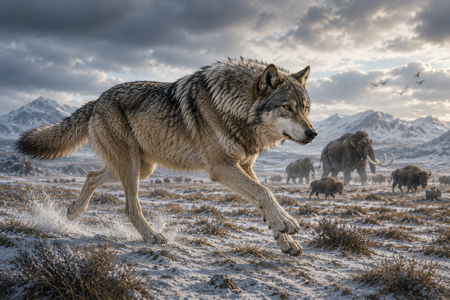
The Twelve Genetic Clues No One Can Yet Explain
Now we arrive at one of the most intriguing pieces of the puzzle.
When Dr. Jennifer Leonard's team extracted ancient mitochondrial DNA from the Beringian wolves, they discovered something they hadn't expected.
Out of just twenty wolves, they identified sixteen different mitochondrial haplotypes.
That sounds incredibly technical, but the idea is actually quite simple.
Think of a mitochondrial haplotype as an ancient family signature passed from mother to offspring. Unlike most of your DNA, which is inherited from both parents and becomes shuffled every generation, mitochondrial DNA is inherited only from your mother. As a result, it acts almost like an unbroken family surname stretching backward through time. If two wolves share the same mitochondrial haplotype, they inherited it from the same maternal lineage somewhere in the distant past.
When Leonard's team compared those sixteen maternal lineages with other wolves, they made another fascinating discovery.
Six of them matched mitochondrial lineages that had already been found in Ice Age wolves from Europe.
But the remaining twelve did not match any modern gray wolves.
Even more surprising, they also did not match any ancient gray wolf populations that had been sampled at the time.
In other words, twelve maternal family lines seemed to belong to... someone.
The question was, who?
The most conservative explanation is also the one most paleontologists accept today.
Those twelve lineages may simply belong to ancient gray wolf populations that have not yet been discovered or genetically sampled. Considering how few Ice Age wolves have yielded usable DNA, that is certainly a reasonable possibility.
But it is not the only possibility.
Remember, science has a way of surprising us.
For generations, scientists believed the dire wolf was simply a larger gray wolf. Ancient DNA eventually showed that assumption was wrong.
Could another surprise still be waiting?
At this point, no one knows.
To answer that question, we would need something that scientists do not yet have: a much broader understanding of the mitochondrial haplotypes that existed within the dire wolf itself. Although researchers have recovered mitochondrial DNA from several dire wolves, they have not yet assembled a population-wide catalog of the maternal lineages that once existed throughout the species.
That leaves us with an intriguing possibility.
If future discoveries eventually uncover the full range of dire wolf mitochondrial haplotypes, researchers could compare them directly to the twelve unexplained Beringian haplotypes.
If none of them match, then the mystery becomes much simpler. Those twelve lineages almost certainly belonged to ancient gray wolves that simply have not been found yet.
But if even one of those maternal lineages proves to be identical to a dire wolf haplotype...
It would force paleontologists to ask an entirely new set of questions about the evolutionary history of the Beringian wolf.
Today, we simply don't know which answer nature will reveal.
But for the first time, we know exactly what question to ask.
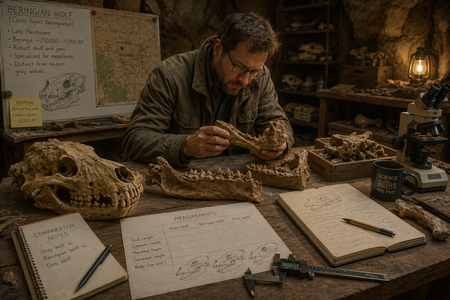
If You Were the Paleontologist...
Let's imagine, just for a moment, that you are the scientist trying to solve this mystery.
You have the fossil bones spread across your laboratory table.
You have the measurements.
You have the ancient DNA.
You have decades of published research.
Now you have to answer a simple question.
Where did the Beringian wolf come from?
The easiest answer is the one most researchers currently favor.
It was simply an ancient population of gray wolves that evolved in isolation on the mammoth steppe. Over thousands of generations, natural selection favored wolves with stronger jaws, broader skulls, and larger teeth because those animals were better equipped to hunt giant Ice Age prey and crack open massive bones for nutritious marrow. In other words, the Beringian wolf and the dire wolf simply evolved to look alike because they occupied similar ecological roles.
That explanation makes good scientific sense.
But is it the only explanation?
Perhaps not.
After all, the Beringian wolf occupies an intriguing middle ground.
It was more robust than a typical gray wolf.
It was generally smaller than a dire wolf.
Its skull and jaws appear more powerful than those of most gray wolves, yet not quite as massive as the largest dire wolves. Its teeth show many of the same adaptations for processing large prey and crushing bone. Even its geographic range has become more interesting. Once believed to live only in Alaska and the Yukon, we now know Beringian wolves reached at least as far south as Wyoming.
Taken one at a time, none of these observations prove anything.
Together, however, they raise an interesting question.
Could the Beringian wolf represent more than simply a specialized gray wolf?
Could it preserve part of an evolutionary story that scientists have not yet uncovered?
At the moment, no one can honestly answer that question.
Ancient DNA has revolutionized paleontology, but it has not solved every mystery. The genomes recovered from dire wolves have answered some remarkable questions, yet they have also revealed how much remains unknown. Likewise, Jennifer Leonard's research uncovered twelve Beringian wolf maternal lineages that have not been identified among modern gray wolves or the ancient gray wolf populations sampled to date.
Those twelve genetic signatures belong somewhere.
Perhaps they belong to ancient gray wolf populations that have simply never been discovered.
Perhaps they represent maternal lineages that disappeared thousands of years ago without leaving descendants alive today.
Or perhaps they point toward an entirely different chapter of Ice Age evolution that has yet to be written.
Today, no one knows.
That is not a weakness in science.
It is one of its greatest strengths.
Science is willing to say, "We don't know... yet."
Every newly discovered fossil, every ancient genome recovered from frozen ground, and every museum drawer opened has the potential to change the story once again.
The Beringian wolf has already surprised us once.
It may not be finished surprising us.
At the Dire Wolf Project, we believe curiosity is every bit as important as certainty. Asking difficult questions doesn't weaken science. It strengthens it. Every discovery begins with someone looking at the evidence and wondering if there might be another explanation waiting beneath the surface. Whether future discoveries support this hypothesis or reject it entirely, we'll be watching with excitement because every new fossil and every ancient genome brings us one step closer to understanding the remarkable predators that once ruled Ice Age North America.
Join us in our work to produce the world's first living dire wolf replica in a 100% domesticated dog. We can't wait to see you there. Click the link to go back in time to where giant mammals ruled the earth: https://mailchi.mp/direwolfproject/sign-up