More GMO "Dire Wolf" puppies?
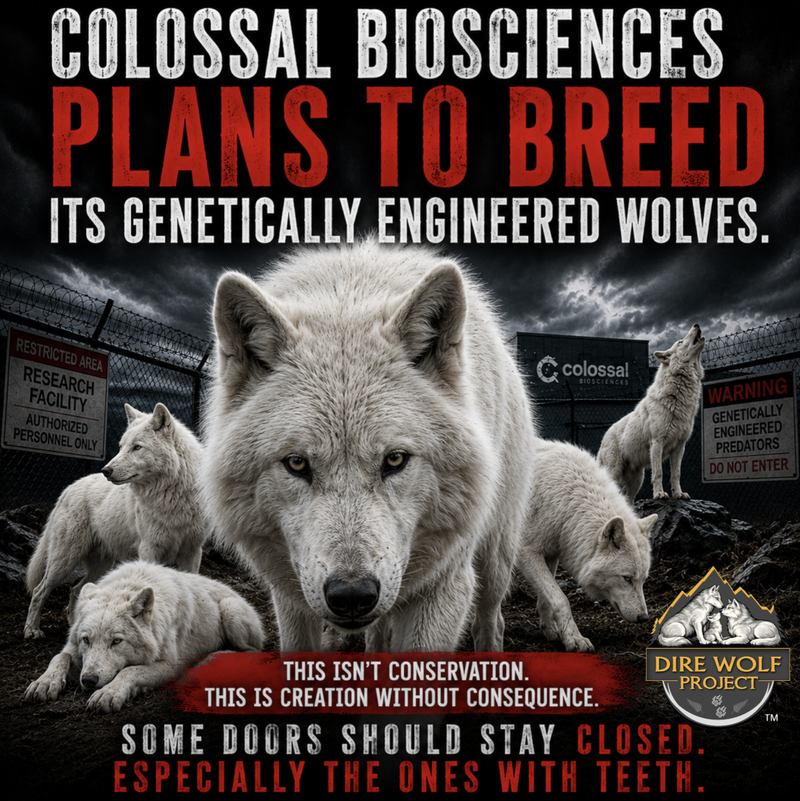

Colossal Biosciences plans to BREED its genetically engineered wolves.
I sat there staring at that sentence for several minutes after reading it because I already knew where this road was leading months ago. The moment the media circus began celebrating three laboratory-created “Dire Wolves,” I knew humanity would not stop at three animals standing behind a fence for photographs. Once mankind convinces itself it possesses the power to redesign life, expansion always follows close behind.
- More animals.
- More experimentation.
- More ambition.
- More confidence.
Mankind's appetite always grows.
And now here we are.
The conversation has already shifted away from the original spectacle and toward building a genetically diverse breeding population through assisted reproduction. In other words, humanity is preparing to establish a sustained lineage of engineered apex predators that will exist entirely because modern biotechnology made it possible.
That should unsettle people far more than it currently does.
The true Dire Wolf belonged to a vanished world. Mammoths once crossed frozen plains beneath an Ice Age sky while enormous bison herds thundered across open tundra stretching farther than the eye could see. Dire Wolves evolved inside that brutal environment over immense spans of time, shaped by prey, climate, disease, competition, starvation, injury, and countless evolutionary pressures modern scientists can never fully recreate or understand. That ancient ecosystem collapsed thousands of years ago, and the predators tied to it disappeared alongside it.
So when I hear people emotionally proclaim that the “Dire Wolf has returned,” I cannot help but feel that humanity has become intoxicated by its own storytelling.
These engineered wolves are not returning home to a waiting ecosystem.
There is no home left.
There are only fenced compounds, carefully controlled breeding plans, containment strategies, and generations of human management stretching indefinitely into the future.
That changes the moral weight of this entire project.
Every breeder understands a simple truth that modern biotech companies seem eager to dance around: when you intentionally create life, you inherit responsibility for the consequences of that life. Not for a press cycle. Not until investor excitement fades. Not until headlines move on to the next scientific marvel. A breeder’s responsibility extends across generations because the animals themselves never asked to be brought into existence.
That responsibility becomes even heavier when the animals involved are apex predators engineered for increased size, heavier bone structure, stronger musculature, larger dentition, and greater physical capability.
Some people hear “20 gene edits” and picture scientists making tiny cosmetic adjustments like changing eye color or coat length. Living systems do not work with that kind of simplicity. Biology behaves more like an enormous spiderweb where tension applied to one strand reverberates through the entire structure in ways nobody fully predicts ahead of time. Genes influence developmental pathways, hormonal systems, stress responses, biomechanics, metabolism, neurological function, and behavioral expression through deeply interconnected relationships researchers are still struggling to map with confidence.
And this is where the public conversation becomes dangerously shallow.
Whether these wolves become more aggressive is not even the primary concern. Physical capability alone changes the equation. Larger jaws alter bite mechanics. Greater body mass changes restraint requirements. Increased musculature changes force generation. A physically larger predator creates a different level of risk simply through the realities of physics and biology. That should not be controversial to acknowledge. Anyone experienced with large animals already understands this instinctively.
Meanwhile, the same society that spent years debating the dangers surrounding gain-of-function research involving microscopic pathogens is now expected to celebrate the deliberate expansion of genetically engineered apex predators as though the ethical concerns somehow disappeared the moment the subject became exciting enough for documentaries and magazine covers.
Back in 1975, scientists gathered at the Asilomar Conference because even they recognized how quickly genetic engineering technology was advancing beyond humanity’s ability to fully anticipate long-term consequences. Those researchers voluntarily established biosafety guidelines because they understood something modern culture increasingly struggles to admit: technological capability does not automatically equal wisdom.
That lesson feels almost forgotten today.
Modern biotech culture increasingly carries this strange assumption that because humanity possesses the ability to manipulate life at the genetic level, we therefore possess the understanding necessary to control every downstream consequence across generations. History repeatedly demonstrates how dangerous that mindset becomes. Human beings are extraordinarily talented at creating systems they later struggle to contain.
And containment is exactly where this conversation eventually leads whether people like it or not.
Wolves are not domestic dogs wandering around a suburban backyard. They are intelligent apex predators possessing immense roaming instincts, environmental awareness, persistence, and problem-solving ability. A growing population of genetically engineered wolves does not remain a temporary laboratory curiosity. It becomes a permanent management burden requiring facilities, containment systems, oversight, funding, political stability, institutional continuity, and human competence decade after decade after decade.
What happens when leadership changes?
What happens when future generations inherit responsibilities they never agreed to carry?
What happens when economic instability, natural disasters, political extremism, or simple human negligence enter the picture over the next hundred years?
Those are not hysterical questions. Those are stewardship questions.
And stewardship requires humility.
That is one of the deepest philosophical differences between the Dire Wolf Project and what Colossal Biosciences is doing. Our work has always remained inside the biological framework nature already established through domestication. We selectively guide existing canine genetics through temperament selection, structural health, stability, and long-term human compatibility developed over generations of careful observation. We respect the immense complexity already present inside living systems.
Modern biotechnology increasingly behaves as though living organisms are software waiting to be rewritten.
That worldview terrifies me.
Because once humanity fully embraces the idea that apex predators may be genetically redesigned and reproduced simply because technology allows it, the line separating stewardship from engineering begins dissolving very quickly. Today the conversation revolves around wolves. Tomorrow the same mindset could justify engineered military animals, genetically altered insects designed for biological delivery systems, or entirely new categories of organisms shaped around human conflict and control.
People grow visibly uncomfortable when those possibilities are spoken aloud, which tells me something important deep inside them already recognizes the danger.
Power is accelerating faster than wisdom.
And history rarely treats that imbalance kindly.
If conversations like this fascinate you… if you find yourself staring out into the modern world wondering where science ends and hubris begins… then you belong inside the Dire Wolf Project™ Inner Circle.
Every evening, thousands of people gather around our digital campfire to explore genetics, domestication, wolves, Ice Age history, breeding ethics, biotechnology, and the rapidly changing relationship between mankind and the animal kingdom.
Some nights we discuss puppies curled beside the fire beneath the stars.
Other nights we confront the darker questions prowling at the edge of modern science.
Either way, you will never look at dogs, wolves, or humanity’s future quite the same again.
Join the Inner Circle here:
Join the Dire Wolf Project™ Inner Circle
Author: Jennifer Stoeckl
Date: May 13, 2026