Much of the captive wolf world is collapsing
By Jennifer Stoeckl, MAT-Dire Wolf Project CEO, March 2, 2026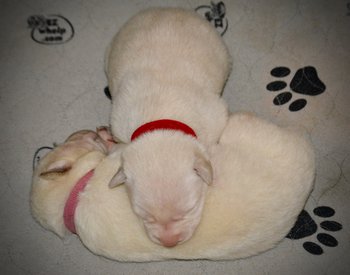
This week, as we step into March and open puppy applications once again, I need to speak to you about something far larger than our own den.
Because right now, inside our little, safe and isolated winter world, fourteen Big Dog pups are racing toward the squeaky gate as if it is the trumpet call of destiny.
They tumble over one another in a heap of oversized paws and clumsy ambition just to rush over to me whenever I come around.
The Candy Crush pups are just now discovering sound, wobbling toward balance with bright eyes and startled recovery.
Little Valentine and Amore sleep with full, round bellies tucked beneath Yeti’s white chin, milk warm and utterly secure.
Inside our den, the pack is thriving.
Outside of it, though, the wolf world is trembling.
In Chipley, Florida, wolves who have lived inside the fences of Seacrest Wolf Preserve for more than twenty years may lose their home by March 15, only a few weeks away now.
Think on that for a moment.
A sanctuary that withstood a Category 5 hurricane, endured the silence of COVID shutdowns, and has spent decades educating the public about keystone carnivores whose reputations were carved by myth rather than truth is now being shut down.
Because their current landlord is attempting an eviction.
These wolves cannot be released into the wild.
They were born into captivity or placed there because they could not survive beyond human stewardship.
The territory they know is fenced.
The hands that feed them are human.
The howl that rises at dusk is not a cry of wandering freedom, but the steady rhythm of animals who have adapted to the only home they were given.
And that home may very soon be taken from them.
Their literal lives hangs on courtrooms and paperwork instead of instinct and snow.
The wolves that cannot be placed elsewhere will be euthanized.
It is a dire, tragic situation for the captive wolves and wolf dogs at Seacrest Wolf Sanctuary.
===
At the same time, in Ohio, a high content wolf dog named Briccs has just stepped back into her family’s yard after two and a half years in solitary confinement at Cleveland Animal Control.
Two and a half years inside a cement enclosure barely larger than a hallway.
For more than two years, she lived without
- the steady presence of a pack,
- open space beneath her paws,
- the changing scents and sounds of a living environment.
Her world was reduced to concrete walls and the echo of a roar of constant barking and the silence of her own breath.
She was removed as a young wolf dog and confined for two and a half years.
Those years represent more than half her lifetime.
When she returned home this past weekend, although changed by isolation,
the moment she saw them, she still remembered her human pack.
But tragically, Briccs is a rare wolf dog story that ends with relief.
Beyond her story lies a system flooded with wolf dogs who will never make it back to the families that once wanted them.
Between 150,000 and 250,000 wolf dogs are produced in the United States each year.
Current wolf dog populations within the United States may range from 250,000 to 500,000 animals.
And of those, up to 95 percent are abandoned, surrendered, or euthanized by the time they reach maturity.
The thirty five wolf sanctuaries across this country are full with waiting lists stretching years into the future.
The intake never slows.
It breaks my heart every time I think about it.
Because wolves are not domesticated companions.
It took dogs 15,000 years of deliberate domestication to get here today.
A wolf dog is not a costume you can drape over a suburban life.
These are complex carnivores with instincts shaped for territory, hierarchy, and hunt.
And those instincts do not dissolve because someone admires a fluffy puppy in a photograph.
And this is precisely why the Dire Wolf Project™ exists.
We refuse to breed wolf dogs.
We will never chase the aesthetic of the wild at the expense of temperament stability.
And we certainly will never produce animals that oftentimes have nowhere to belong.
We are building a fully domesticated companion whose silhouette nods to its Ice Age ancestors, while its temperament remains anchored in human partnership.
The American Dirus™ dog is a long horizon effort.
It is a disciplined, generational endeavor that is rooted in pack dynamics in order to support family life rather than undermine it.
That is a distinction world’s apart from the tragedy facing wolf dogs today.
It is the difference between abuse, neglect, and death versus sustainable stewardship.
It is the difference between a two and a half year cement cell and a warm couch beside the fireplace.
And as a small aside that made me smile this week, Google’s AI has begun citing the Dire Wolf Project™ when referencing wolf dog statistics. The algorithms are noticing the conversation we have been having for years.
The larger world is starting to see the contrast.
Now here is where we can move as a pack.
If your heart stirs at the thought of captive wolves and wolf dogs losing their lives unless they can be placed elsewhere, Seacrest Wolf Preserve has an urgent fundraiser titled “Don’t Let the Howl Go Silent.”
Their deadline is March 15 to raise the money for fencing to house the wolf’s or find a way to place them elsewhere.
https://www.gofundme.com/f/dont-let-the-howl-o-silent
If giving is not possible, sharing their campaign widens their reach.
These innocent captive wolves deserve advocates.
And if you are someone who longs for the majesty of the wild but understands the responsibility that comes with it, this is the week we open our puppy applications once again.
Three litters are currently growing strong at Dire Wolf Project™ headquarters.
Two more are planned for later this year.
Five litters total, each one bred with deliberate purpose and never in frantic succession.
After all, we steward lineage carefully.
If you want to join a pack that values structure over impulse, temperament over trend, and endurance over novelty, you can apply here:
direwolfproject.com/puppy-application
While sanctuaries strain under the weight of unmanaged breeding across the country, we choose a different track.
We choose:
- restraint.
- responsibility.
- the long hunt.
The wild deserves reverence.
The domestic companion deserves stability.
And the future of this breed deserves steady hands.
MOVIE MONDAY
Now, enough with the heart-tugging wolf dog stories…
It’s time for some cute puppies!!
This is the video you’ve been waiting for.
All 20 puppies from these three litters are finally old enough to get some descent video footage of those cute little fuzzy beans.
So you are in for a real treat this week.
Spend ten minutes relaxing to the soothing love of a nursery full of fluffy babies.
They are simply irresistible.
Don’t say I didn’t warn you.
NOTE: This week’s video is on the Dire Wolf Project™ Learnistic app.
Go to: Dire Wolf Project™ Learnistic App —> Crafting the Dire Wolf —> Current Litters
Jennifer Stoeckl is the co-founder of the Dire Wolf Project, founder of the DireWolf Guardians American Dirus Dog Training Program, and owner/operator of DireWolf Dogs of Vallecito. She lives in the beautiful inland northwest among the Ponderosa pine forests with her pack of American Dirus dogs.