How do you fit 2 moms and 20 puppies in 300 square feet?
By Jennifer Stoeckl, MAT - Dire Wolf Project CEO, Feb. 23, 2026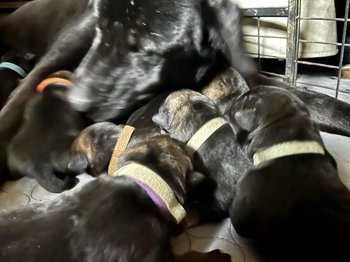
There are moments in this work when you realize you have officially crossed into territory that would sound completely unreasonable if you said it out loud to anyone outside the pack.
This was one of those moments.
It was the coldest stretch of winter, with nighttime temperatures dropping to 14 degrees, and I was standing inside a 300-square-foot motorhome asking myself a very serious question.
Where, exactly, do you put another momma dog who is clearly about to give birth… when you already have two other moms nursing litters, one of which contains fourteen puppies?
Because that was the situation.
Galena had gone first on January 28th, delivering the Big Dog litter.
Fourteen puppies.
Fourteen!
She and her babies were settled into a small x-pen enclosure in the living room, which at that point had officially stopped functioning as a living room and was now something closer to a neonatal ward.
Then Maggie followed on February 10th with the Candy Crush litter.
Four puppies, including the two little ones who gave us all a few sleepless nights at the beginning.
Maggie and her crew were stationed at the foot of my bed, separated by a baby gate that latched into the hallway.
The gate was covered with a blanket for warmth and privacy, because momma dogs take boundaries seriously.
And then there was Yeti.
Very pregnant, very determined, and very clear that her babies were coming whether I had a plan or not.
The clock was ticking.
I briefly considered moving the Big Dog puppies outside.
They are sturdy, robust little tanks, but this would have been their very first night outdoors, and with temperatures that low, it felt like an unnecessary risk.
There was no reason to introduce cold stress on night one.
I considered putting Yeti down in the annex (which is a small shed attached to the door to our motor coach which houses the woodstove).
On paper, placing her and her puppies in the annex made sense.
In reality, though, the annex cools quickly if the fire goes out in the woodstove overnight, and newborn puppies need steady warmth.
It is also down the stairs, out of earshot, out of eyesight, and directly in the path of every female who needs to go outside several times a day.
I could not justify it.
That left exactly one option.
The hallway.
I measured.
I remeasured.
And then I held my breath.
The x-pen fit perfectly.
And just like that, the hallway became a third nursery space.
Yeti and her two white Be Mine babies, Valentine and Amore, settled into their new hallway den.
Maggie remained at the foot of my bed with her Candy Crush litter behind the baby gate.
And Galena stayed in the living room with her fourteen.
Three moms…
Three litters…
One very narrow corridor of human traffic now filled completely with puppies and their moms.
This is where the delicate choreography began.
Every time Maggie needed to come out, the routine went like this.
First, I lifted Valentine and Amore and placed them gently into a cushion-lined wicker basket.
They waited there patiently, two tiny white fluffy babies nestled together into the basket.
Then Yeti went outside.
Only after Yeti was safely out could Maggie step into the hallway.
Whenever Maggie went out, Galena decided she had to go out, too.
Once Maggie finished her business, she returned to her den.
Then Galena came in and settled back with her puppies.
Only after both moms were secure did Yeti return inside, followed by the careful return of her two babies to the hallway pen.
Then, reverse the process for the next trip.
Over and over again.
At first, everyone was suspicious.
Momma dogs are protective, and privacy matters when you are responsible for small lives.
But dogs are also astonishingly adaptable when routines are consistent and leadership is calm.
Within days, the system became routine.
Valentine and Amore learned that the basket meant “wait a moment.”
Yeti learned that Maggie was not invading her space.
Galena carried on as if managing fourteen puppies in a living room was the most reasonable thing in the world.
And somehow, improbably, it worked.
No one was left out in the cold.
Every mother had her own territory.
Every puppy had warmth, milk, and peace.
No one was stressed.
And I learned that with enough gates, pens, blankets, and a sense of humor, even a motorhome can become a perfectly coordinated winter den for all three moms.
Good thing they did not all have fourteen puppies!
See all three litters here:
https://direwolfdogs.com/dogs-for-sale/future-litters/
Sometimes this job demands real creativity.
And other times, it demands endurance.
This time, the situation demanded both, plus a willingness to turn a hallway into a carefully laid out nursery for newborns.
The pack adapted and so did I.
MOVIE MONDAY
Modern dog breeding rarely identifies itself with eugenics anymore, yet many of its operating assumptions remain unchanged from the Victorian eugenics mindset. The language has softened in our modern world, but many of the same eugenics logic from the Victorian age still guides many breeding decisions.
You might be surprised to learn that you continue to hold a leftover eugenics belief without even knowing it.
This week’s video explains the twelve lingering eugenics ideas in today’s modern dog breeding and how the Dire Wolf Project flips the script on its head in order to reject them all.
Jennifer Stoeckl is the co-founder of the Dire Wolf Project, founder of the DireWolf Guardians American Dirus Dog Training Program, and owner/operator of DireWolf Dogs of Vallecito. She lives in the beautiful inland northwest among the Ponderosa pine forests with her pack of American Dirus dogs.