The Chihuahua that saved us from the folding chairs
By Jennifer Stoeckl, MAT - Dire Wolf Project CEO, June 9, 2026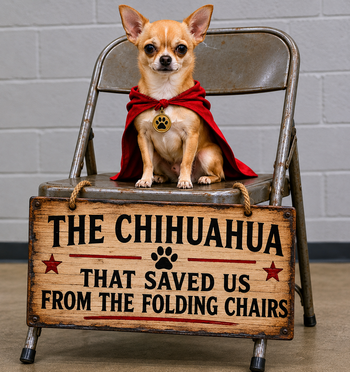
Good morning
There are many mysteries in life, like:
Who built Stonehenge?
What happened to the lost colony of Roanoke?
Why do socks disappear in the dryer?
And perhaps most importantly:
What, exactly, were those folding chairs planning?
I ask because a few years ago I found myself standing in a parking lot watching a Chihuahua react to a stack of folding chairs with the level of concern usually associated with incoming meteor strikes.
The chairs belonged to a man unloading supplies from the back of a pickup truck.
At least, that's what it looked like to me.
The Chihuahua had reached a different conclusion.
You could see it in his face.
The little guy wasn't simply making noise.
He had become convinced that something deeply suspicious was unfolding right in front of us, and he was apparently the only citizen willing to do anything about it.
Nobody by him seemed particularly alarmed.
The man kept unloading chairs.
I just stood there watching, mesmerized by the whole ordeal.
His owner wore the expression of someone who had already sat through this exact presentation many times before.
The dog barked with renewed urgency as another stack emerged from the truck.
The man, apparently unmoved by these warnings, added it to the growing pile.
That only confirmed the Chihuahua's suspicions.
He doubled down.
Every chair that came out of the truck seemed to validate his theory.
The unloading operation, meanwhile, continued as if no emergency had been declared.
The Chihuahua responded with the sort of determination usually found in people trying to stop an alien invasion using only a flashlight and a strongly worded letter.
Meanwhile, his owner simply waited.
Years of experience had apparently taught her that the fastest path forward was to let the performance exhaust itself.
Then she sighed.
It was a magnificent sigh.
The sigh of a woman who had probably apologized to strangers on behalf of this dog hundreds of times.
Without the slightest sense of urgency, she bent down, tucked the tiny revolutionary under one arm, and resumed her walk.
The dog continued issuing warnings as they disappeared around the corner.
And eventually the man finished unloading the truck.
The chairs sat exactly where he'd left them.
And everyone went on with their day.
That's when a strange thought wandered into my head.
As far as the Chihuahua was concerned, the operation had been a complete success.
He had discovered the threat, alerted the public, and prompted immediate intervention from higher authorities.
The fact that this intervention involved being carried away like an angry handbag probably seemed like a minor procedural detail.
But what interested me
wasn't really the dog.
It was the owner.
The owner never had to persuade the Chihuahua that folding chairs were harmless.
She didn't need to improve his judgment, explain why patio furniture wasn't plotting against society, or spend fifteen minutes working through a training exercise.
The entire situation ended because she possessed a simple advantage:
The dog weighed about as much as a bag of groceries.
And that very fact gave her a bunch of options.
The more I thought about it, the more I noticed how often owners solve problems for small dogs before the dogs ever have a chance to solve them for themselves.
When trouble appears, a small dog can be:
- redirected,
- carried away,
- lifted onto something,
- removed from something, or
- physically separated from whatever questionable decision is currently underway.
Human beings are remarkably effective problem-solvers when the problem is portable.
Then along comes a giant dog.
Of course, the first thing most people notice is their size.
What took me years to appreciate is that size isn't the most important change; it's the very reason the entire relationship changes.
Once a dog reaches a certain size, both sides of the leash are forced to improve.
The dog has to develop better judgment, and the owner has to become more skilled at communicating because physically rearranging the situation is no longer an effective long-term strategy.
That observation also helped explain something I'd recognized for years: some giant dogs are remarkably easy to live with while others seem determined to challenge every decision and instruction.
Temperament explains a great deal here.
Over the years, I've met giant dogs that approached every request as though they had been appointed to a regulatory board.
Before any action could be taken, there would apparently need to be a review period, several committee meetings, and an opportunity for public comment.
I've met others that seemed genuinely interested in understanding what their owners wanted.
Instead of negotiating every request, you're working with a dog that pays attention, processes information, and generally assumes there's a reason you're asking.
With a dog that simply follows instructions without question, training moves faster, daily routines become easier, and small challenges are less likely to turn into prolonged arguments.
The difference isn't measured in pounds; it's measured in cooperation.
This is one of the reasons we've spent decades emphasizing temperament in the American Dirus™ dog.
People see the size first.
That's understandable.
A giant dog with a dire wolf appearance tends to attract attention.
What has always interested me more is the temperament living inside that body, though.
When a dog naturally looks to its family for information, learns quickly, and wants to cooperate, the entire experience of owning a dog transforms.
Training becomes less of a negotiation and more of an ongoing conversation.
There are still things to teach, habits to shape, and occasional moments that leave everyone wondering what just happened, but progress tends to feel like something you're building together.
Yet both sides begin from the same fundamental assumption that they're working together rather than pulling in opposite directions.
After all these years, what I really want to know from a dog’s mind is what happens when something unexpected appears.
Does the dog gather information from its family before deciding how to respond?
Or does it immediately appoint itself Chief Investigator of the Folding Chair Crimes Unit?
Because somewhere out there is a Chihuahua who remains absolutely convinced he saved us all.
If you'd like to learn more about training, handling, and building a successful partnership with a giant dog, you'll find our growing collection of articles inside the DireWolf Guardians™ training library:
https://direwolfproject.com/direwolf-guardians/
===
P.S. The folding-chair case remains open. Witnesses remain uncooperative.