The old elitist kennel club philosophy is beginning to crack
By Jennifer Stoeckl, MAT - Dire Wolf Project CEO, June 1, 2026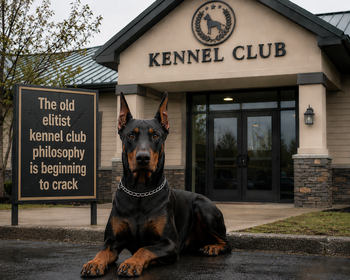
Yesterday on our Facebook page, I posted the news about the Finnish Kennel Club approving a formal Doberman outcross program.
Then I braced myself.
Because if there is one thing the dog world can do with astonishing efficiency, it is turn a genetics discussion into a literal bloodbath.
Especially when the words “crossbreeding” and “purebred” appear in the same sentence.
I fully expected the usual sequence of events.
Someone accusing Finland of “destroying” the Doberman.
Someone else declaring all purebred dogs are now genetically doomed.
A few drive-by commenters tossing emotional grenades into the comment section before wandering back into the wilderness.
Instead, something happened that I never expected.
People started thinking.
I know… I couldn’t believe it either.
But real, goodness to gracious, breeders began sharing experiences.
One woman talked about old kennel club investigations from decades ago where supposedly purebred dogs suddenly produced off-standard puppies.
Their registration paperwork was challenged.
And entire breeding programs came under suspicion because a puppy appeared with ears that sat wrong or a coat type that did not match expectations.
Strict standardized purity meant everything in purebred dog breeding in the early 90’s (and still does to a large degree).
Another breeder from France entered the discussion and completely shifted the tone of the conversation.
She breeds Finnish Lapponian Herders, in France, of course.
Her response was emotional, raw, and deeply personal.
She described losing trust in parts of the breeding community after one of her young dogs developed Dilated Cardiomyopathy at only three years old.
According to her, she tried sounding the alarm about cardiac disease within certain lines and felt silenced or dismissed for speaking openly.
That comment really hit me for its deeply personal regret.
Suddenly this was no longer a debate between “pro-crossbreeding” people and “anti-crossbreeding” people.
It quickly turned into a real discussion with various breeders from all around the world standing inside the same storm from different directions.
One person saying, “Closed populations are collapsing under inherited disease.”
Another saying, “Be careful introducing genetics from populations carrying their own hidden problems.”
And to tell you the truth...
Both concerns are valid.
This is because there are no pristine bloodlines wandering untouched through some mythical frozen valley beyond the reach of genetics.
Every breed carries baggage.
Every population has recessive mutations, weaknesses, bottlenecks, trends, vulnerabilities, and health issues quietly moving through the generations like cracks beneath river ice.
Some breeds simply hide them better than others.
The Doberman situation is particularly brutal because the numbers are so staggering.
Estimates suggest roughly 60% of Dobermans may develop Dilated Cardiomyopathy during their lifetime.
Sixty percent!
At that point, breeders are no longer discussing cosmetic imperfections or minor faults in ear carriage.
They are discussing survival of the breed itself.
And that is why Finland’s decision is so significant.
One of the world’s established kennel clubs publicly acknowledged something Dire Wolf Project™ breeders have quietly understood since 1988:
- A closed gene pool is not immortal.
- Eventually, biology collects its debt.
Now, this is the point where some people immediately assume the Dire Wolf Project™ believes all crossbreeding is automatically good.
We do not.
Random crossing without long-term goals, population management, temperament selection, structural consistency, health tracking, or generational planning creates instability.
A breeder can absolutely destroy predictability by treating genetics like a slot machine.
What we believe in is strategic, systematic crossbreeding used carefully and intentionally when a population genuinely requires new diversity.
The Strongbred™ philosophy was built around the understanding that a healthy breeding population behaves more like a living ecosystem than a museum exhibit frozen behind glass.
There are seasons where preservation and stabilization become the priority.
There are other moments where genetic diversity must be reintroduced thoughtfully in order to prevent long-term decline.
Those decisions should never be emotional or impulsive.
They should be driven by data, transparency, long-term observation, and the courage to confront uncomfortable realities with honesty.
What fascinated me about the Finnish decision was not simply the outcross itself.
It was the also admission.
A major kennel club openly acknowledged that preserving the future of a breed may sometimes require controlled genetic expansion rather than permanent isolation.
That is an enormous philosophical shift inside the purebred world.
Especially because the dogs are not being secretly crossed in somebody’s backyard while pretending to remain purebred.
The project is documented with the kennel club's full support.
They've even developed separate developmental registries to designate the crossbred dogs within the project while the population is monitored over generations.
That level of transparency is the key to correctly rebuilding the standardized Doberman once they have achieved their aim within the crossbred line.
And truthfully, watching breeders wrestle publicly with these questions gave me a strange sense of hope.
Nobody involved sounded like cartoon villains pounding each other over the head with an anvil.
These were people who clearly loved dogs and carried years of experience, grief, frustration, pride, and hard-earned caution into the discussion.
For once, instead of watching the internet devour itself, I watched breeders actually engage honestly with difficult biological realities.
That is so rare online anymore.
Almost unnervingly rare.
I certainly did not expect that yesterday when I hit “Post,” but I sure am glad to be a part of it.
You can read the many heartfelt responses from caring breeders who've chosen to follow the Dire Wolf Project™ on our Facebook page:
Don't forget to follow us while you’re there and join in the discussions.
Jennifer Stoeckl is the co-founder of the Dire Wolf Project, founder of the DireWolf Guardians American Dirus Dog Training Program, and owner/operator of DireWolf Dogs of Vallecito. She lives in the beautiful inland northwest among the Ponderosa pine forests with her pack of American Dirus dogs.