We Have Officially Entered the Era of the $50,000 Eyeball
By Jennifer Stoeckl, MAT - Dire Wolf Project CEO, June 2, 2026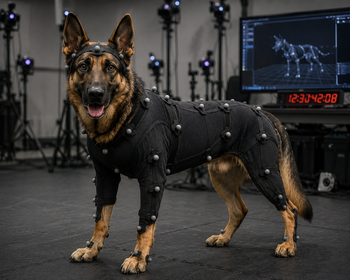
Somewhere in England right now, a German Shepherd is trotting across a laboratory floor wearing reflective motion-capture markers while an array of cameras, sensors, force plates, and scientific equipment worth more than a brand new pickup truck records the shocking discovery that...
its back end moves strangely.
Meanwhile, somewhere else on Earth, an old rancher with arthritis in both knees squints across a pasture, spits into the dirt, and says, “That dog ain’t built right.”
And the funny part?
They both reached the exact same conclusion.
I nearly fell out of my chair laughing when I read the newest study out of the University of Surrey this week because it perfectly captures something bizarre happening in modern culture right now.
We are slowly training ourselves to distrust our own eyes unless a credentialed institution stamps approval on what we already know.
For decades now, ordinary dog owners have watched certain modern German Shepherd Dog show lines move like shopping carts with a bad wheel.
People have been saying, “That cannot possibly be healthy,” since disco was still playing on the radio.
But now, finally, after enough cameras, sensors, computers, gait analysis software, expensive laboratory equipment, and people in white coats gathered around the glowing monitors...
Science has bravely announced that exaggerated structure affects movement.
Well, done, science. Well done.
Truly groundbreaking times we live in.
I say all of this with affection for science, by the way.
I love science, and I adore genetics.
I could happily spend half my life buried in studies about Ice Age predators and ancient canine evolution while the other half disappears into spreadsheets and pedigrees like some kind of caffeinated dire wolf cryptid haunting the woods of eastern Washington.
Oh wait… I’ve already done that.
But this growing cultural phenomenon truly fascinates me.
We have somehow convinced ourselves that direct observation no longer counts as knowledge.
A breeder can watch a dog move every single day for twelve years.
They can:
- see looseness in the joints.
- watch weak rear movement develop.
- notice instability in the hocks.
- observe inefficient gait mechanics,
- poor structure,
- fatigue during exercise,
- the subtle rolling motion that tells you the hips are not tight.
Yet somehow, if they say, “I do not like the way this dog moves,” modern culture responds as though they just attempted to diagnose a nuclear reactor using tarot cards.
“But where is the official paperwork?!”
someone shouts from the stands.
The paper and the machines become sacred, while the human eye becomes suspicious.
And that is deeply disturbing when you think about it.
Human beings became extraordinary animal breeders long before radiographs existed.
Shepherds, hunters, stockmen, cavalrymen, and livestock breeders shaped entire bloodlines through relentless observation.
They watched movement, structure, and performance ability the way wolves watch a limping elk crossing frozen ground.
- Tiny shifts in balance.
- Weakness in the rear.
- Structural inefficiency.
- Endurance failure.
- Recovery after exertion.
They understood these things because survival depended on understanding them.
Observation WAS the technology!
Now, does this mean modern diagnostics are useless?
Of course not.
Tools are wonderful when they sharpen wisdom.
The danger begins when people stop trusting wisdom unless it comes attached to a laboratory invoice.
That is where things become almost comical.
Because here is the uncomfortable truth nobody likes saying out loud:
- You can have an entire folder full of certifications while the dog standing in front of you still moves poorly.
- You can also have a breeder with no alphabet soup attached to their name who can identify structural weakness from fifty feet away simply because they have spent thirty years watching dogs move across real terrain instead of polished concrete floors.
Experience leaves tracks in the brain the same way wolves leave tracks in snow.
And truthfully, the German Shepherd Dog debate may be one of the greatest examples of this entire phenomenon.
People have BEEN noticing the excessive rear angulation for years.
Even people who know almost nothing about dogs often look at certain exaggerated shepherds and instinctively feel that something appears... off.
Now science has arrived carrying a stack of graphs confirming what many ordinary eyes already understood.
Anyhow, if you want to read the study yourself and see the world’s most expensive confirmation that eyeballs still function properly, you can find it here:
University of Surrey Study on German Shepherd Movement
And if you love the noble beauty of the German Shepherd Dog but prefer a more level-backed, structurally balanced family companion built for calm movement rather than dramatic ring exaggeration, you can see our available American Dirus™ puppies here:
Available American Dirus™ Puppies
Because sometimes the old instincts still work just fine.
And sometimes you really can trust your eyes.
Jennifer Stoeckl is the co-founder of the Dire Wolf Project, founder of the DireWolf Guardians American Dirus Dog Training Program, and owner/operator of DireWolf Dogs of Vallecito. She lives in the beautiful inland northwest among the Ponderosa pine forests with her pack of American Dirus dogs.