The invisible rules every animal follows
By Jennifer Stoeckl, MAT - Dire Wolf Project CEO, June 30, 2026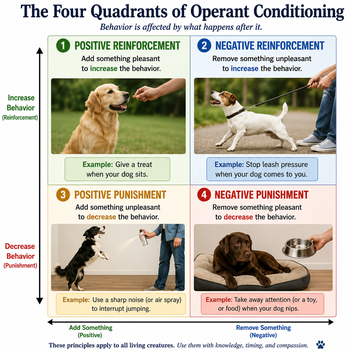
What if I told you there is a framework that quietly governs how every puppy, horse, dolphin, eagle, and even the tiny goldfish in your living room learns?
You can't see or touch it.
Yet it has been shaping animal behavior since the beginning of time.
The remarkable part is that one curious American devoted his life to discovering it.
Before we meet him, we should tip our hat to another scientist whose work helped set the stage.
Most dog owners have heard of Pavlov's dogs.
While studying digestion, the Russian physiologist discovered that animals could learn to associate one event with another.
A sound that consistently predicted dinner eventually became enough to make his dogs salivate before the food ever arrived.
His work, later called classical conditioning, became one of the first great scientific insights into animal learning.
It was an extraordinary discovery, to be sure.
But it also left behind an even larger question.
Just how DO animals learn?
That question found a home in the mind of an American psychologist named B.F. Skinner.
Born in a small town in Pennsylvania in 1904, Skinner seemed to possess an endless curiosity about how the world worked.
As a boy, Burrhus Frederic Skinner was forever building mechanical toys, homemade gadgets, and little inventions that solved everyday problems.
If something worked, he wanted to know why.
If it could work better, he wanted to know how.
Looking back, it almost seems inevitable.
The little boy who spent his afternoons taking things apart grew into the man who spent his adulthood taking learning apart.
Surprisingly, science wasn't his first ambition.
After graduating from college, Skinner spent nearly two years trying to become a novelist.
Eventually, he accepted that writing was not the path his life would take.
Rather than viewing that disappointment as the end of a dream, he allowed it to become the beginning of another.
A single question captured his imagination.
How do living creatures learn?
After all, people had been training animals for thousands of years.
Shepherds depended upon faithful sheepdogs.
Falconers flew hawks across open fields to retrieve winged prey.
Horsemen shaped dependable mounts through patience, consistency, and encouragement.
But despite thousands of years of practical success, the underlying concepts of how animals learn to work with humans remained only partly understood.
One dedicated American made it his life's work to uncover the fundamental principles behind these remarkable moments.
It was an astonishingly ambitious goal.
If learning followed an orderly framework, then the same principles should appear whether the student had two legs, four legs, wings, fins, or flippers.
So B.F. Skinner did what curious Americans have always done.
He built something.
His simple experimental chamber, later nicknamed the Skinner Box, allowed him to observe behavior under carefully controlled conditions.
Instead of relying on stories or assumptions, he could watch learning unfold one decision at a time.
The patterns were unmistakable.
Behavior was not random.
What happened after a behavior occurred determined whether it would occur again.
For the first time, learning itself could be observed, measured, tested, and better understood.
Skinner called this operant conditioning.
In simple terms, it describes how behavior is shaped by its consequences.
When something pleasant is added after a behavior, it tends to increase.
When something unpleasant is removed, the behavior can also grow.
On the other hand, adding something unpleasant or removing something desirable can decrease a behavior.
These four possibilities—positive reinforcement, negative reinforcement, positive punishment, and negative punishment—form the basic framework through which all learning unfolds.
His students, Keller and Marian Breland, wondered whether these principles extended beyond the laboratory.
They began working with species after species to test Skinner's ideas.
- Dogs.
- Chickens.
- Pigs.
- Dolphins.
- Raccoons.
- Birds.
- And even fish.
Again and again, the same underlying framework appeared.
The natural learning principles B.F. Skinner had uncovered held true.
Later generations carried those discoveries into the real world.
Trainers refined different philosophies, developed new techniques, and sometimes disagreed passionately about the best ways to teach animals.
Those discussions continue today.
Yet beneath nearly every modern conversation about animal training lies the same remarkable truth.
Learning is not random.
It follows discoverable principles.
As America celebrates 250 years of independence, I find something deeply inspiring in that.
America has always celebrated explorers.
Some crossed oceans.
Others mapped rivers and mountain ranges.
Still others unlocked the secrets of electricity, flight, medicine, and space.
But, B.F. Skinner explored a frontier no one could see.
He spent his life searching for the invisible framework that has quietly guided learning for all since the beginning of Creation.
He didn't create those principles any more than Newton created gravity.
He simply helped the rest of us understand them.
The next time your dog suddenly understands something you've been trying to teach, remember that you're witnessing far more than a successful training session.
You're seeing a glimpse of an elegant order woven throughout the living world, an order one curious American spent a lifetime bringing into the light.
One of the things I love most about raising puppies is watching these timeless principles unfold before my eyes.
As you know, learning isn't something that happens only in laboratories.
It happens in every puppy pen, in those quiet moments when a curious glance turns into a cautious first step, and a young dog begins to make sense of the world around her.
Lollipop Meadow reminds me of that every single day.
She isn't the sort of puppy who rushes headlong into every new experience.
She watches, thinks, and quietly gathers information before making a decision.
As one of our Omega Dogs, she possesses a gentle, deeply intuitive nature that seems to absorb the world around her.
You can almost see the gears turning behind those thoughtful eyes.
Puppies like Meadow flourish when someone enjoys the journey of teaching just as much as the destination.
She isn't simply waiting for commands; she's building a relationship, discovering patterns, and learning how to navigate life alongside her family.
If you've been looking for an exceptionally intelligent companion with a tender heart and a wonderfully thoughtful spirit, I hope you'll spend a few minutes getting to know Lollipop Meadow.
https://direwolfproject.com/pedigree/7532/
Sometimes the greatest joy isn't teaching a dog something new.
It's watching a remarkable young mind discover just how much it can learn.
Jennifer Stoeckl is the co-founder of the Dire Wolf Project, founder of the DireWolf Guardians American Dirus Dog Training Program, and owner/operator of DireWolf Dogs of Vallecito. She lives in the beautiful inland northwest among the Ponderosa pine forests with her pack of American Dirus dogs.